
Paper is not a continuous solid. Every sheet — from lightweight tissue to heavy corrugated linerboard — is a porous network of plant fibers, formed when a dilute fiber suspension drains on a forming surface and consolidates under pressure and heat. The structure of that network determines everything: strength, formation, surface quality, and machine runnability.
Understanding how fiber characteristics translate into sheet properties is foundational knowledge across the paper industry — for process engineers optimizing a furnish, equipment designers specifying a refiner, buyers evaluating a pulp grade, or managers benchmarking production quality.
Two Fiber Types. Different Roles.
Commercial papermaking uses predominantly wood pulp, which falls into two categories based on botanical origin and cell structure.
Long-fiber pulp (softwood) — pine, spruce, fir — produces tracheids 2.5–4.0 mm in length. Their size and cell wall thickness allow them to span wide areas within the fiber network and absorb energy before fracture. This makes them essential for tear resistance, tensile breaking length, and wet-web strength on the paper machine.
Short-fiber pulp (hardwood) — eucalyptus, birch, acacia — produces fibers 0.7–1.6 mm long. Thinner-walled and more numerous per unit mass, they pack tightly and form more inter-fiber contacts. Their contribution is inter-fiber bonded area, formation uniformity, surface smoothness (measured by PPS or Bendtsen methods), and opacity.
Most commercial grades blend both types to balance structural reinforcement with bonding performance.
Table 1 — Fiber Type Comparison
| Fiber Type | Typical Length | Common Sources | Primary Contribution to Paper |
| Long fiber (softwood) | 2.5 – 4.0 mm | Pine, spruce, fir | Tear resistance, tensile breaking length, wet-web strength |
| Short fiber (hardwood) | 0.7 – 1.6 mm | Eucalyptus, birch, acacia | Inter-fiber bonded area, formation uniformity, surface smoothness, opacity |
How Fiber Characteristics Drive Paper Properties
Macroscopic paper performance emerges from the fiber network’s microscopic architecture. The five characteristics below are the primary engineering variables that papermakers, equipment engineers, and furnish designers work with:
- Fiber length — determines the network’s ability to distribute and absorb mechanical stress. Longer fibers improve tear resistance (Elmendorf tear test, TAPPI T 414) and tensile breaking length.
- Fiber flexibility and conformability — controls how well fibers conform to each other during consolidation. More flexible fibers achieve greater relative bonded area (RBA), directly raising tensile and burst strength. Refining increases flexibility through external fibrillation (loosening surface fibrils) and internal fibrillation (delaminating the S2 cell wall layer).
- Inter-fiber bonding — hydrogen bonds between cellulose hydroxyl groups are the primary cohesive force in dry paper. Bond density depends on fiber surface area, pressing conditions, and wet-end chemistry (cationic starch, dry-strength resins). Insufficient bonding reduces tensile and burst strength; excess bonding at the cost of fiber length reduces tear resistance — the classic tensile–tear trade-off.
- Fiber distribution (formation) — uniform fiber distribution minimises basis weight variation. Poor formation causes local weak spots, reducing mechanical uniformity and print quality. Formation quality is measurable using beta formation testers or optical scanning methods.
- Fiber coarseness — the mass per unit length of a fiber. Higher coarseness (softwood) contributes bulk and bending stiffness; lower coarseness (hardwood) raises opacity and surface smoothness.
Table 2 — Fiber Characteristics and Paper Performance
| Fiber Characteristic | Effect on Paper | Process Control Lever |
| Fiber length | Longer fibers improve tear resistance and tensile breaking length | Furnish blend ratio (softwood/hardwood) |
| Fiber flexibility / conformability | Greater fiber conformability increases relative bonded area (RBA), raising tensile and burst strength | Refining intensity, expressed as specific edge load (SEL, J/m) |
| Inter-fiber bonding | Higher hydrogen bond density strengthens sheet integrity and internal bond strength | Pressing pressure, wet-end chemistry (starch, dry-strength resin) |
| Fiber distribution (formation) | Uniform distribution reduces basis weight variation and improves printability | Headbox design, jet-to-wire ratio, approach flow consistency |
| Fiber coarseness | Lower coarseness (hardwood) raises opacity and smoothness; higher coarseness (softwood) adds bulk and bending stiffness | Pulp species selection |
Each characteristic can be measured and actively managed through pulp selection, refining, and process design.
Where Fiber Properties Are Shaped in the Process
Fiber characteristics are not fixed from the pulp bale to the reel. They evolve at every stage of the papermaking process:
Stock preparation and refining is where fiber flexibility and bonded surface area are actively engineered. Disc or conical refiners apply mechanical energy — expressed as specific edge load (SEL, in J/m) — to cause external fibrillation (loosening surface fibrils) and internal fibrillation (swelling within the S2 cell wall layer), improving bonding potential at the cost of freeness (drainage resistance, measured as Canadian Standard Freeness in mL or Schopper-Riegler °SR). Refining is the most powerful in-process lever for tensile and burst strength.
Approach flow and headbox govern how uniformly fibers are distributed when they reach the wire. Consistency, pressure stability, turbulence, and jet-to-wire speed ratio all affect formation quality and fiber orientation anisotropy (the MD/CD strength ratio).
Forming section determines the initial fiber network geometry. In a Fourdrinier former, drainage occurs from one side only, creating a two-sided sheet. Twin-wire formers — including blade formers, roll formers, and gap formers (where the jet enters directly into a gap between two converging wires) — drain from both sides simultaneously, improving formation significantly, particularly for hardwood-rich or high-basis-weight furnishes.
Press section consolidates the wet sheet, increasing sheet density and strengthening inter-fiber hydrogen bonding. Extended nip (shoe) presses apply pressure over a longer contact zone, achieving higher post-press dry content (DC%) and improved tensile and burst strength compared with conventional roll presses.
Engineering Fiber Performance Across the Production Line
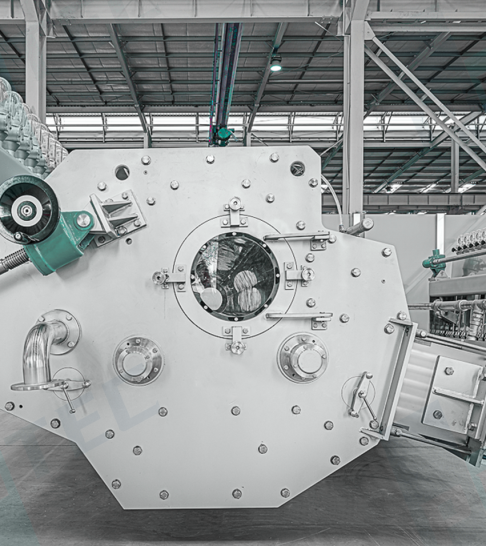
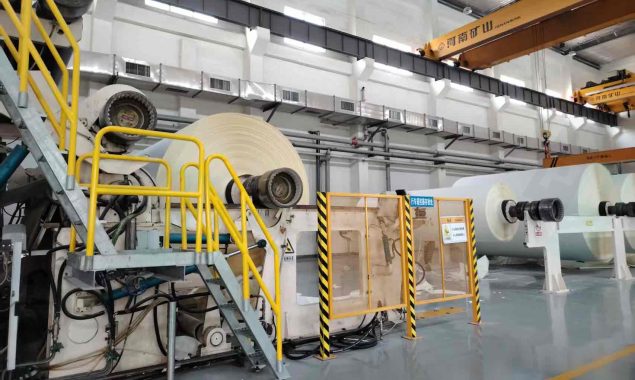
Every stage described above depends on equipment designed with a clear understanding of how fiber behaves under process conditions. PMTEC supplies papermaking machinery and process engineering support across stock preparation, approach flow, and forming systems — covering both the mechanical design of equipment and the process logic that governs fiber treatment at each stage.
For paper mills, this means a single engineering partner with visibility across the full fiber-to-sheet process — relevant whether you are optimizing an existing line, evaluating a furnish change, or specifying equipment for a new project.
Summary
Paper strength and quality originate in fiber structure. Long fibers reinforce; short fibers bond. Refining adjusts flexibility and bonded surface area. Forming and pressing fix the network. Managing these variables — through pulp selection, furnish blending, and equipment configuration — is the discipline that separates a well-engineered paper grade from an inconsistent one.
For professionals across the paper industry, fiber science is the common technical language connecting raw material selection, process engineering, and final product performance.