
Specialty paper is built on furnish compositions and coating chemistry that standard printing and packaging paper never needed, which is why it sits across finance, aerospace, electronics, and defense manufacturing. This guide covers the industry’s three-tier classification system, the engineering history behind carbonless copy paper, and what structurally separates specialty paper from standard grades.
Classification: Processed Paper, Specialty Paper, and Functional Paper
Papermaking and paper processing developed in stages, and the industry sorts the results into three tiers that build on one another rather than sit in isolation.
The tiers are not static. As furnish technology, coating chemistry, and converting processes advance, specialty-paper grades continue to expand, with new formulations entering commercial production on an ongoing basis.
| Tier | What it involves | Typical examples |
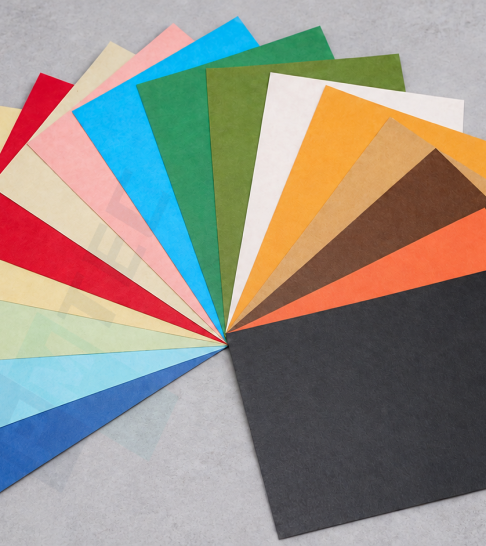
| Processed paper | A single, straightforward modification to base paper — changing appearance or one basic property, used in traditional everyday settings | Single-coated art paper, solid-dyed colored paper, embossed napkin tissue |
| Specialty paper | A deeper modification to structure, raw material, or process, giving the paper properties standard paper does not have | Carbonless copy paper, flame-retardant paper, electrical insulation paper |
| Functional paper | A further technical upgrade of specialty paper, engineered around one extreme, targeted function | High-barrier packaging paper, conductive paper, filtration media |
Case Study: Carbonless Copy Paper and the CB/CFB/CF Structure
The grade widely credited as the industry’s first true specialty paper is carbonless copy paper. It was developed by chemists Barrett “Barry” Green and Lowell Schleicher at the National Cash Register Company (NCR) in the United States. The underlying patent was filed in 1953, and the product reached commercial sale in 1954 under the NCR Paper brand — the origin of the “carbonless copy paper” name still used today.
The system runs on a three-sheet coating architecture. The top sheet — CB, or coated back — carries a layer of microencapsulated chromogenic dye on its underside. The bottom sheet — CF, or coated front — carries a reactive clay or phenolic-resin developer coating on its top face. Any middle sheets in a multi-part set are CFB, coated on both sides: developer on the front, dye microcapsules on the back. Writing or impact pressure ruptures the microcapsules, releasing dye that migrates into contact with the developer coating on the sheet below and forms a permanent mark — the mechanism that eliminated the separate carbon-transfer sheet entirely.
The industry classifies it as specialty paper on four grounds:
| Criterion | Standard paper | Carbonless copy paper |
| Structure | Single-layer fiber sheet | A set of top, middle, and bottom sheets, each with a multi-layer coated structure |
| Raw materials | Basic additives such as rosin size and modified starch | Purpose-built microcapsules, colorless dye, and developer chemicals |
| Processing | Little or no extra coating required | Multiple functional coatings applied in sequence, layer by layer |
| Typical application | Everyday printing and publishing | Finance, aerospace, electronics, and defense-related documentation |
Once carbonless copy paper established the category, several earlier processed-paper grades were retroactively reclassified as specialty paper as well — one reason some industry references describe specialty paper as an extension of processed-paper technology rather than a wholly separate track.
Material and Process Differentiation from Standard Furnish
Standard paper draws on a plant-fiber furnish — wood, bamboo, or straw pulp — processed with conventional sizing and minimal coating. Specialty paper starts from that same base furnish but adds chemical fiber, mineral fiber, carbon fiber, or metal fiber, then layers on functional coatings or impregnation chemistry engineered around one target property. A flame-retardant grade, for example, is built to resist ignition and sustained combustion where an equivalent commodity sheet burns readily; the performance gap comes from the additive package and coating structure, not from a different papermaking process in principle.
Practitioners summarize the category with a shorthand: four new — new raw materials, new processes, new equipment, new product categories; three high — high technical threshold, high specialized performance, high industrial value; two difficult — difficult to manufacture, difficult to recycle after disposal.
Because each grade is engineered for a narrow, well-defined end use, segment volumes stay small relative to commodity paper, niche markets saturate quickly, and a given specialty grade’s commercial lifecycle tends to run shorter than a general-purpose grade’s.
Classification Stability: Does Specialty-Grade Status Change Over Time?
Whether specialty paper is a fixed category or a moving one is disputed within the industry. One position holds that once a grade reaches steady, high-volume production and its underlying chemistry becomes common practice across mills, it functionally graduates into a standard processed-paper grade — carbonless copy paper is the usual example, since decades of scale production have led some classification schemes to now list it as processed paper rather than specialty paper.
Others reject that framing, holding that the two categories are defined by distinct technical criteria — structural complexity, raw-material profile, and engineered performance — that don’t change just because production volume increases.
Processed paper is the base-level modification; specialty paper layers a targeted, engineered upgrade on top of it; functional paper pushes that upgrade to a single, extreme performance target. Domestic specialty-paper manufacturing still trails more established international supply chains in furnish and coating technology, which keeps it a priority development area.
Frequently Asked Questions
What structurally distinguishes specialty paper from standard paper?
Standard paper is a single-layer, plant-fiber sheet with minimal treatment. Specialty paper adds non-plant fibers to the furnish and applies functional coatings or impregnation chemistry engineered around one target property, which is why it typically requires additional process stages that standard paper doesn’t.
What was the first specialty paper, and how does it work?
Carbonless copy paper, developed at NCR in the early 1950s, is widely credited as the first true specialty paper. Its CB/CFB/CF sheet structure uses microencapsulated dye and a reactive developer coating that react under pressure to form an image without a separate carbon sheet.
Is carbonless copy paper still classified as specialty paper today?
This is debated. Some classification schemes now treat it as processed paper, since decades of mass production have made the chemistry standard practice. Others maintain its original specialty-paper classification, arguing the underlying technical criteria haven’t changed.
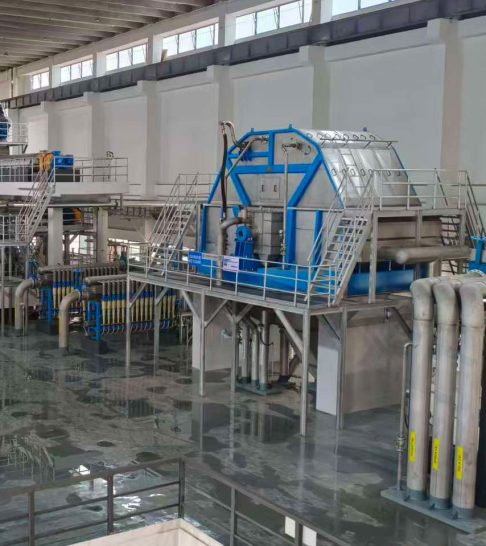
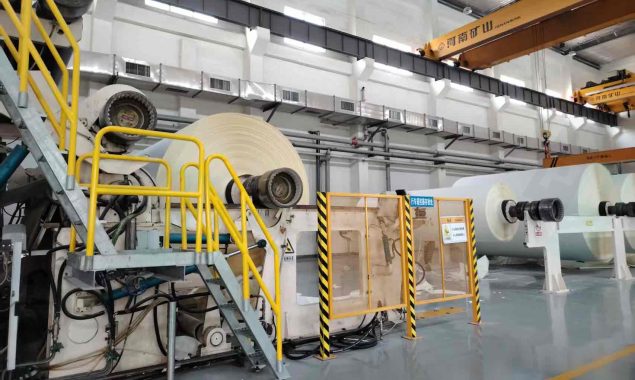
PMTEC is a full mill solutions provider for the pulp and paper industry, engineering machinery systems for paper grades ranging from standard base stock to multi-layer specialty and functional paper.
This overview of specialty paper classification and origins reflects the process knowledge behind that equipment design.