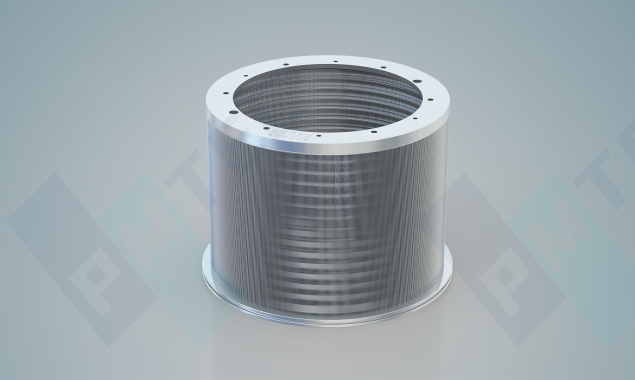
Refiner plates are the principal wear components inside a disc, conical, or cylinder refiner. Their bar geometry governs how fibre is treated, how much electrical energy the process consumes per tonne of pulp, and how long the machine runs between plate changes.
1、How Refiner Plates Work
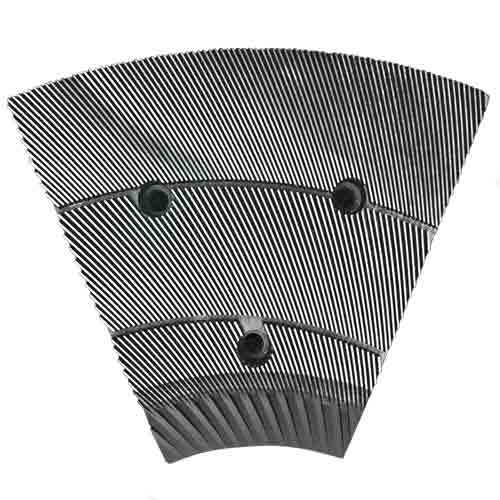
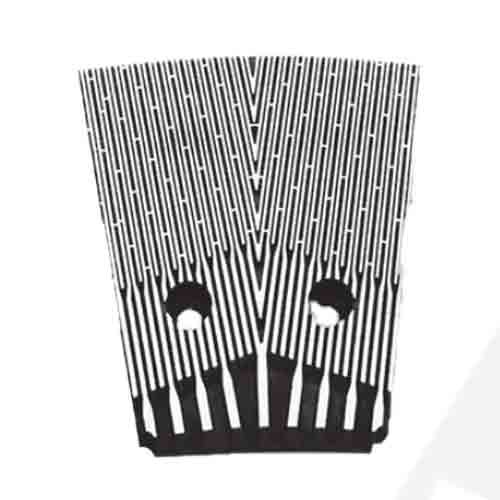
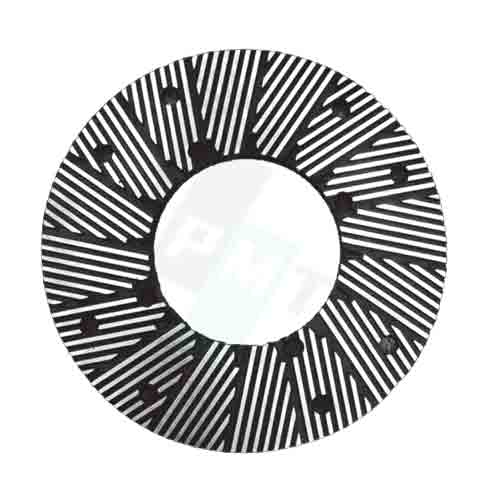
Inside a disc refiner, one plate rotates and one stays fixed. Pulp passes between the two faces. Each time a bar on the rotating plate crosses a bar on the stationary face, a brief intense shear event occurs — this bar crossing fibrillates the cellulose fibres, roughening their surfaces, increasing bonding area, and building the strength properties the finished sheet requires. The groove between the bars carries fibres through the refining zone; groove dimensions are as critical to the result as bar dimensions.
Specific Edge Load (SEL) — energy per unit length of bar crossing, in J/m — determines treatment intensity. Low SEL favours fibre development with minimal cutting and suits tissue and fine-paper grades. High SEL drives more aggressive treatment for coarse furnishes or rapid freeness reduction.
Cutting Edge Length (CEL) — total bar-crossing length per rotor revolution, in km/rev — determines how many treatment events occur per unit time. Higher CEL generally gives more uniform fibrillation at the same power input. A plate specification is the combination of bar geometry that places the process at the right SEL and CEL for the furnish and target quality.
2、Plate Types
Eight types of refiner plate are used across pulp and paper, board, and process industries. The distinctions matter: each type is designed for a specific machine configuration, feed material, and process objective — and specifying the wrong type will not give the correct result regardless of other parameters.
Pulping Disc Refiner Plates
Pulping disc refiner plates operate in high-consistency defibrators at 20 to 40% consistency, processing wood chips into fibre. Plates are typically three-zone: a coarse outer zone for chip defibration, a transition zone, and a finer inner zone for fibre development. Available from 32″ to 82″ diameter. The 82″ plate is the highest-capacity size; operating data show 600 t/day output at 700 kWh/t energy consumption and 5–8 MW start-up power.
Papermaking Disc Refiner Plates
Papermaking disc refiner plates operate at low consistency — 3 to 5% — in stock preparation ahead of the paper machine. The bar pattern is finer than a pulping refiner plate (narrower bars, shallower grooves) to maximise bar crossings per revolution and develop fibre bonding without shortening fibres. Available from 14″ to 58″ and in the CC450 configuration.
Conical Refiner Plates
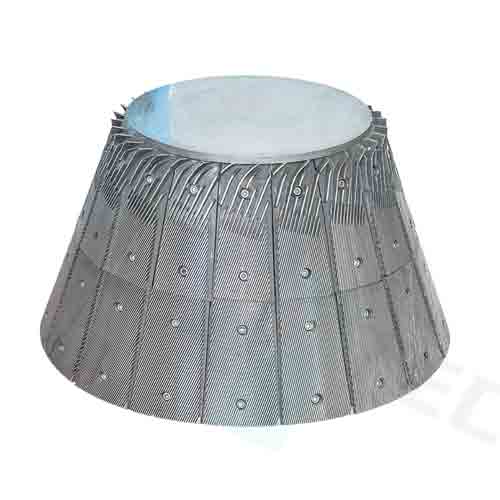
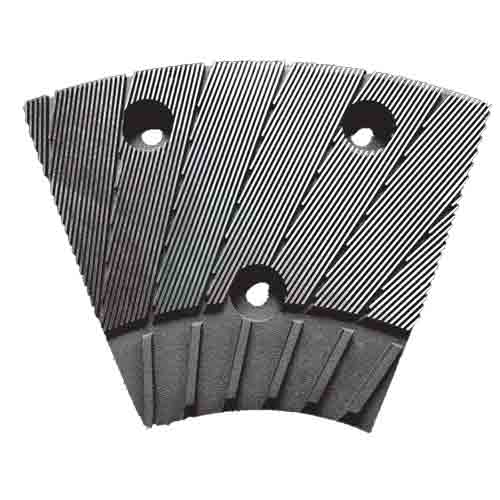
In a conical refiner the rotor is a tapered plug rotating inside a conical housing. The conical geometry tends to produce lower SEL at equivalent power compared to a disc refiner of similar size, making it well suited to long-fibre furnishes and grades where fibre length must be preserved. Plates are available in integral one-piece castings or in split format — sets of 10 or 14 individual plates per stator or rotor assembly — allowing individual worn plates to be replaced without dismounting the full cone. Four standard integral sizes cover Ø460 to Ø1000 mm; a continuous custom range extends from Ø230 to Ø1350 mm.
Cylinder Refiner Plates
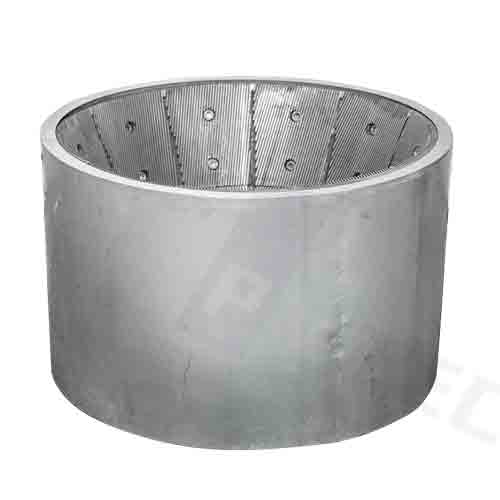
Cylinder refiners use a rotating inner drum and a fixed outer shell, with refining on the curved faces between them. The rotor and stator carry opposing bar patterns that follow the cylinder radius. Available in Ø380 mm, Ø450 mm, and Ø650 mm rotor diameters. Used in speciality pulping and certain stock preparation systems.
Heat Dispersion Refiner Plates
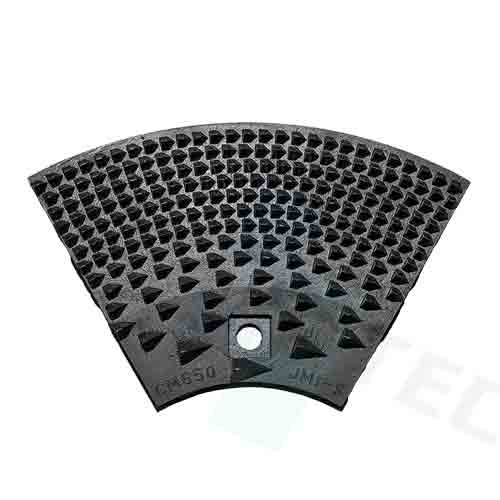
Heat dispersion refiner plates are used in hot dispersers on OCC and recycled-fibre lines to reduce ink particles and contaminants to a size that can be removed in downstream flotation or washing. This is not a refining process — the objective is ink particle reduction, not fibre development. The plate surface carries pins or studs rather than bars, generating turbulent blending at 80–95°C. Available from 20″ to 54″, in flat-disc and conical configurations.
MDF Refiner Plates
MDF refiner plates are designed for thermomechanical fibreboard refining at steam pressure ≥ 8 bar and temperature > 160°C — conditions that exceed what standard paper-mill refiner plates can withstand. The bar geometry is coarser (wider bars, deeper grooves) to handle high-bulk wood chip feed. High-chrome alloy cast iron is mandatory for this application. Available from 24″ to 62″.
Starch and Pharmaceutical Refiner Plates
Starch and pharma refiner plates apply the disc-refiner principle to particle-size reduction, not fibre development. The plate surface carries pins, not bars. Food-contact applications require 316L stainless steel with food-contact certification. Pharmaceutical applications additionally require a polished surface finish and full batch-level material traceability. Available from 24″ to 48″.
3、Specification and Selection Reference
The three tables below cover plate sizes and specifications, bar geometry parameters, and material grade selection. All dimensional data is sourced from manufacturer catalogues.
TABLE 1 — REFINER PLATE TYPES: SIZES RANGE AND OPERATING SPECIFICATIONS
| Plate Type | Available Sizes | Refiner Type | Consistency (%) | Bar / Tooth Pattern | Standard Material |
| Pulping Disc Refiner Plates | 32″ – 82″ | High-consistency disc refiner | 20 – 40 | Multi-zone bar pattern (coarse → fine), chip defibration | HCCI |
| Papermaking Disc Refiner Plates | 14″ – 58″ | Low-consistency disc refiner | 3 – 5 | Fine bar pattern, high bar-crossing density | Martensitic SS / HCCI |
| Conical Refiner Plates (Integral) | Ø230 – Ø1350 mm | Conical refiner | 3 – 6 | Gradual bar transition, lower SEL | Martensitic SS / HCCI |
| Conical Refiner Plates (Split) | Ø230 – Ø1350 mm | Conical refiner | 3 – 6 | Gradual bar transition, lower SEL | HCCI |
| Cylinder Refiner Plates | Ø380 – Ø650 mm | Cylinder refiner | 3 – 10 | Curved bar, opposing rotor/stator pattern | HCCI |
| Heat Dispersion Refiner Plates | 20″ – 54″ | Hot disperser (flat-disc or conical) | 20 – 30 | Pin/stud type, turbulence-based | HCCI |
| MDF Refiner Plates | 24″ – 62″ | Thermomechanical refiner | ≥ 25 | Coarse geometry, high-load operation | HCCI |
| Starch / Pharma Plates | 24″ – 48″ | Disc refiner | Process-specific | Pin-type, particle size reduction | SS 316L |
Table 1. Disc plate sizes in inches (″). Conical plate sizes as: Ø rotor large-end dia. × length × Ø shaft-bore (mm). Split format as: Ø rotor large-end dia. × length (mm) — pieces per assembly. Cylinder plate sizes as Ø rotor dia. (mm). Bar and pin dimensions in mm. Consistency in % by weight.
TABLE 2 — BAR /TOOTH GEOMETRY(TYPICAL RANGES)
| Plate Type | Bar Angle (°) | Bar Width (mm) | Groove Width (mm) | Groove Depth (mm) | Key Features |
| Conical Refiner Plates | 12.5 – 24 | 1.8 – 6.5 | 2 – 8 | 7 – 12 | Uniform refining |
| Pulping Disc Refiner Plates | 15 – 24 (outer zone typical) | 2.5 – 6.5 | 3 – 8 | 9 – 12 | Multi-zone design |
| Papermaking Disc Refiner Plates | 12.5 – 24 | 1.8 – 6.5 | 2 – 8 | 7 – 12 | Fine structure |
| MDF Refiner Plates | 15 – 24 | 3.0 – 7.0 | 4.0 – 9.0 | 10 – 16 | Heavy-duty |
| Heat Dispersion Refiner Plates (Pin) | N/A | 3 – 8 (pin dia.) | 4 – 10 (pin gap) | 8 – 14 (pin ht.) | Turbulence dispersion |
| Starch / Pharma Refiner Plates (Pin ) | N/A | 4 – 10 (pin dia.) | 5 – 12 (pin gap) | 8 – 14 (pin ht.) | Particle control |
Table 2. All bar dimensions in mm; bar angle in degrees (°). Conical plate parameters are verbatim manufacturer catalogue values. Pin-tooth types (heat dispersion and starch/pharma) use pin diameter, gap, and height in place of bar width, groove width, and groove depth — all in mm.
TABLE 3 — MATERIAL GRADE SELECTION
| Material Grade | Hardness | Abrasion Resistance | Corrosion Resistance | Impact Toughness | Recommended Applications |
| ALLOY GRADES — Pulp, Paper and Board |
| High-Chrome Alloy Cast Iron (HCCI) | HRC 58 – 65 | Very high | Moderate | Low | Pulping, MDF, Heavy-duty |
| Martensitic Stainless Steel | HRC 44 – 56 | High | Good | Good | Papermaking, OCC |
| Austenitic Stainless Steel (18/8) | HB 180 – 240 | Moderate | Very high | Very high | Tissue, Low-intensity |
| FOOD-CONTACT AND PHARMACEUTICAL GRADES — Starch and Regulated Applications |
| SS 316L (Food-grade) | HB 160 – 210 | Moderate | Excellent | Excellent | Food |
| SS 316L (Pharma-grade) | HB 160 – 200 | Moderate | Excellent | Excellent | Pharma |
Table 3. All plates supplied to ISO 9001 quality standards. Hardness values: HRC (Rockwell C scale) for cast iron grades; HB (Brinell) for stainless steel grades. Material certification and dimensional inspection reports supplied with each order.
4、How Specifications Are Determined
Four inputs define the correct plate specification for a given application:
- Furnish: fibre species, virgin or recovered origin, degree of hornification in recycled fibres, and contaminant levels determine the required treatment intensity and alloy grade.
- Target quality: target freeness (CSF or °SR), tensile index, or fibre length distribution sets the operating point on the SEL–CEL map.
- Machine: installed motor power, rotor diameter, rotational speed, and gap adjustment range define the achievable operating envelope for a given plate geometry.
- Operating constraints: plate-change interval, energy cost per tonne, and maintenance schedule determine which specification is economically optimal, not only technically correct.
PMTECS REFINER PLATE SUPPLY
PMTECS supplies the full range of refiner plate types described in this guide — pulping disc, papermaking disc, conical (integral and split), cylinder, heat dispersion, MDF, and starch/pharmaceutical — across the size ranges listed in Table 1. All plates are manufactured to ISO 9001 standards. Each order is accompanied by dimensional inspection reports, hardness test certificates, and full material traceability documentation. Technical enquiries are assessed against machine configuration, current plate specification, furnish type, and process targets before supply is confirmed.