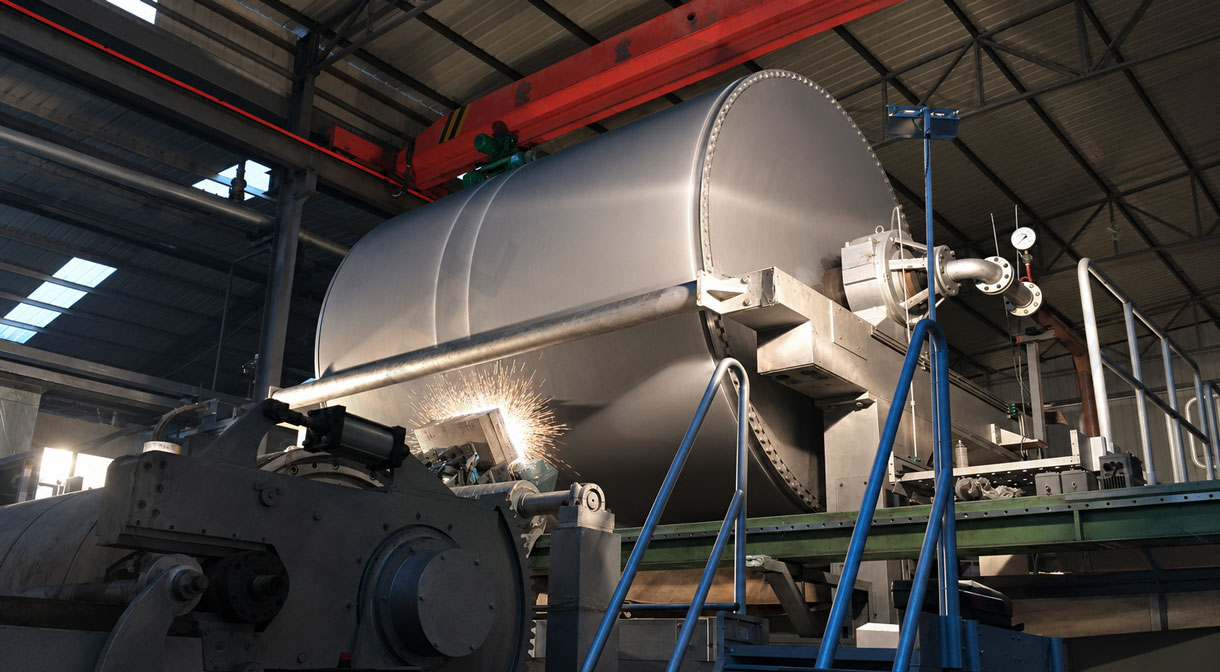
Stainless steel dryer cylinders carry higher steam pressure and resist condensate corrosion, but conduct heat less well than cast iron. This comparison covers wall thickness, design pressure, drying capacity and service life for paper machine dryer sections, and identifies the cases where cast iron is still the better choice.
Table 1. Stainless steel and cast iron dryer cylinders at a glance (Ø1500 mm reference)
| Item | Cast iron dryer cylinder | Stainless steel dryer cylinder |
| Construction | Cast shell with integral heads | Rolled and welded plate |
| Typical shell thickness | 25 – 30 mm | 12 – 16 mm |
| Typical design pressure | 0.35 – 0.5 MPa | 0.6 – 1.0 MPa |
| Corresponding surface temperature | 145 – 155 °C | 165 – 185 °C |
| Condensate-side corrosion | Continuous, uneven pitting | Negligible |
| Shell inspection | Not practical volumetrically | UT and RT on welds |
| Failure mode | Brittle fracture | Leak before break |
| Vibration damping | High | Low |
| Relative first cost | Lower | Higher |
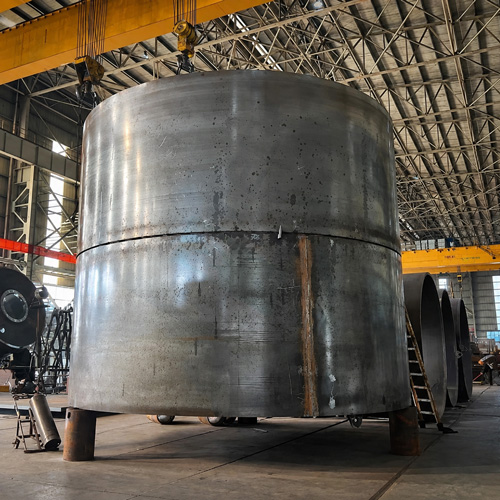
Why is cast iron the traditional dryer cylinder material?
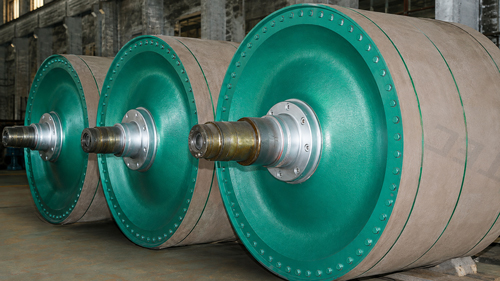
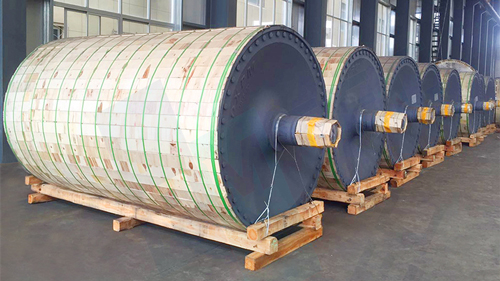
Grey cast iron casts into a large shell with integral heads, machines well, conducts heat at around 50 W/m·K and damps vibration better than any steel. For paper machine dryer sections operating below roughly 0.5 MPa steam it remains a sound and economical material.
There are cast iron dryer cylinders still in production after fifty years. The case for stainless steel begins where the cast iron design meets its own limits.
What are the limits of a cast iron dryer cylinder?
- Pressure ceiling. Grey iron has almost no ductility, with elongation below one percent, so it fails without warning rather than leaking first. Pressure vessel codes answer this with large safety factors, and those factors set the ceiling in Table 1.
- Condensate-side corrosion. Dissolved oxygen and carbon dioxide attack the bore and pitting develops under the condensate film. Part of the cast iron wall is corrosion allowance rather than working structure.
- Unverifiable material. Porosity and wall thickness variation exist in every casting, and ultrasonic inspection of grey iron is unreliable because graphite flakes scatter the signal.
- No pressure-retaining repair. Metal stitching can close a crack cosmetically, but weld repair of a grey iron pressure boundary is not accepted. A cracked shell means replacement.
How does a stainless steel dryer cylinder differ in construction?
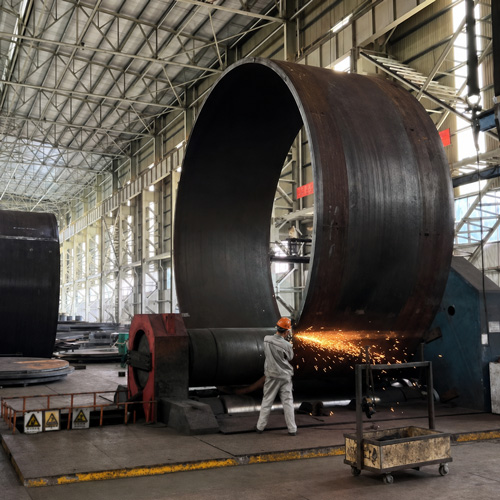
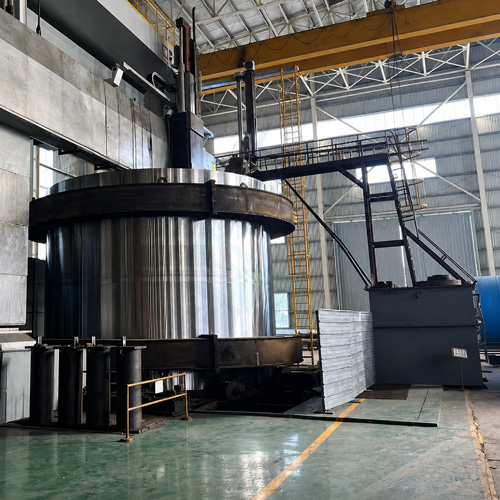
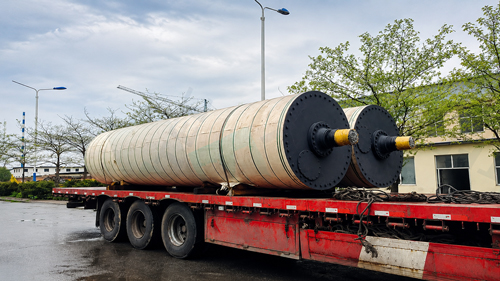
The shell is rolled and welded from plate rather than cast. Allowable stress is higher, welds can be radiographed and ultrasonically tested, and the material is ductile, so the failure mode becomes a leak rather than a burst.
Wall thickness is not set by pressure alone, and this is where most comparisons go wrong. For Ø1500 mm at 1.0 MPa the pressure calculation for 304 gives well under 10 mm. The specified 12 to 16 mm comes from shell stiffness, deflection under self-weight and doctor load, machining and regrind allowance, and the internal groove or spoiler bar arrangement. Cast iron carries all of that plus casting soundness and corrosion allowance, which is why its wall is roughly twice as thick.
Table 2. Material properties relevant to dryer cylinder design
| Property | Grey cast iron HT250 (GG25) | Stainless steel 304 / 06Cr19Ni10 | Carbon steel Q345R (reference) |
| Tensile strength | ≥ 250 MPa | ≥ 520 MPa | 490 – 620 MPa |
| Yield strength | Not defined | ≥ 205 MPa | ≥ 345 MPa |
| Elongation | < 1% | ≥ 40% | ≥ 21% |
| Thermal conductivity | 48 – 52 W/m·K | 16 – 20 W/m·K | approx. 45 W/m·K |
| Thermal expansion | approx. 11 × 10⁻⁶ /K | approx. 17 × 10⁻⁶ /K | approx. 12 × 10⁻⁶ /K |
| Density | 7.2 g/cm³ | 7.93 g/cm³ | 7.85 g/cm³ |
| Weld repairable | No | Yes | Yes |
Does the lower thermal conductivity of stainless steel reduce drying capacity?
Per millimetre of wall, yes. Austenitic stainless steel conducts heat at 16 to 20 W/m·K against 48 to 52 for grey cast iron. At cylinder level the thinner stainless shell narrows this to roughly a seven percent loss in overall heat transfer coefficient, which the higher steam pressure recovers several times over.
1. Cast iron shell, 28 mm at 50 W/m·K, gives a conduction resistance of about 5.6 × 10⁻⁴ m²·K/W.
2. Stainless steel shell, 14 mm at 17 W/m·K, gives about 8.2 × 10⁻⁴ m²·K/W, worse by roughly 2.6 × 10⁻⁴.
3. The shell is one resistance in series with the condensate film, the scale layer, sheet contact and the felt side. For a well-drained cylinder with an overall coefficient near 300 W/m²·K, total resistance is about 33 × 10⁻⁴, so the stainless shell costs about seven percent.
The penalty moves with the assumed overall coefficient: closer to ten percent at 400 W/m²·K, below six at 250 W/m²·K.
That arithmetic uses clean-metal conductivity, which flatters cast iron. A cast iron bore accumulates iron oxide and scale over years of service while a stainless bore does not, so the as-new gap narrows with age.
Where the penalty does bite is on machines that cannot raise steam pressure, because there the stainless cylinder gives up heat transfer and gets nothing back. Stainless clad plate answers that case: a carbon steel base of 11 mm with a 3 mm bonded stainless cladding gives a combined resistance near 4.2 × 10⁻⁴, better than cast iron, while keeping a stainless surface on the condensate side. Fabrication costs more and the cladding bond has to be verified.
How much drying capacity does a higher design pressure add?
Evaporation rate follows the overall heat transfer coefficient multiplied by the temperature difference between cylinder surface and sheet. Raising design pressure from 0.4 to 1.0 MPa lifts saturation temperature from 152 to 184 °C, and the temperature difference rises far faster than the coefficient falls.
Table 3. Illustrative drying rate comparison, sheet surface at 98 °C
| Configuration | Steam pressure (gauge) | Saturation temperature | Temperature difference | Relative drying rate |
| Cast iron | 0.4 MPa | 152 °C | 54 K | 100% |
| Stainless steel | 0.7 MPa | 170 °C | 72 K | approx. 125% |
| Stainless steel | 1.0 MPa | 184 °C | 86 K | approx. 149% |
Illustrative. Actual gains depend on condensate removal, sheet grade, felt condition and dryer section balance.
A dryer section built for higher pressure needs fewer cylinders for the same production, or produces more from the same number, which on a rebuild often decides whether the existing section can support a speed increase without extending the machine hall. The gain requires the whole dryer group to be rerated: a single stainless cylinder installed inside a cast iron group runs at group pressure and delivers no additional capacity.
What is corrosion resistance worth over the life of a dryer cylinder?
Cast iron bores corrode wherever condensate sits, and the damage is worst on machines with long shutdowns, seasonal operation or poor deaeration. Pitting is uneven, so wall thickness measurement returns an average that hides the thinnest points. Stainless steel removes this failure path entirely.
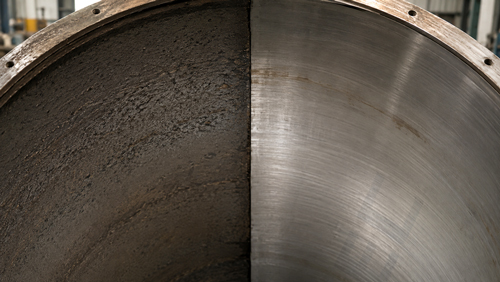
The cost shows up in three places. Inspection intervals shorten as recorded minimum wall thickness falls. Iron carried into the condensate system fouls heat exchangers and appears in boiler feedwater chemistry. And a cast iron shell rusts externally during any extended shutdown, which transfers to the sheet on startup. For tissue, decor paper, filter paper and food contact grades, that last point alone justifies stainless steel, and it is the same reasoning that has made welded steel the standard shell material for new Yankee dryers, where surface condition directly controls creping quality.
When is a cast iron dryer cylinder still the right choice?
Cast iron is not obsolete, and specifying stainless steel everywhere wastes money.
- Vibration damping. Grey iron absorbs vibration far better than steel, which matters for doctor blade chatter and for dryer sections with a history of barring. A steel cylinder transmits more of what the doctor does.
- Surface behaviour. Cast iron holds a doctoring surface well. Austenitic stainless is softer, work hardens unevenly and can gall, so a hardened or coated surface with a matched doctor blade specification is usually required.
- Cost. On a low-pressure section running a grade that does not need the extra temperature, cast iron delivers the same result for less.
What should be checked before specifying a stainless steel dryer cylinder?
1. Steam and condensate system capability. The capacity gain depends on higher pressure, so confirm the steam supply, cascade design, separators and condensate pumps can carry it before the cylinder is ordered.
2. Siphon and spoiler bar design. Higher differential pressure and a thinner wall change condensate behaviour. Rotary siphon clearance and spoiler bar spacing should be recalculated rather than carried over.
3. Thermal expansion. Stainless expands roughly fifty percent more than cast iron. Head-to-shell joints, journal fits, doctor settings and bearing clearances all need checking at operating temperature, not cold.
4. Surface specification. Define hardness, finish and any coating together with the doctor blade material. Most complaints about stainless cylinders originate here.
5. Pressure vessel certification. Confirm the design code, the stamping, and that the certification is accepted in the destination country.
6. Head and journal material. Heads and journals are often not the same material as the shell. Check the joint design and the corrosion exposure of each part separately.
Frequently asked questions
Is a stainless steel dryer cylinder better than cast iron?
For new dryer sections designed above 0.6 MPa, and for grades where surface marking or condensate iron is a problem, yes. On a low-pressure section running a tolerant grade, cast iron gives the same result at lower cost.
What steam pressure can a stainless steel dryer cylinder run?
Welded stainless shells of Ø1500 mm are commonly designed for 0.6 to 1.0 MPa, against 0.35 to 0.5 MPa for an equivalent cast iron cylinder. The working limit is set by the design code applied and by the steam and condensate system, not by the shell alone.
Can cast iron dryer cylinders be replaced with stainless steel one at a time?
Yes, but a single cylinder runs at the pressure of its group, so the replacement delivers corrosion resistance and surface cleanliness rather than added capacity. Capacity gains require the group to be rerated.
What is a stainless clad dryer cylinder?
A carbon steel shell with a bonded stainless layer on the condensate side. It keeps carbon steel thermal conductivity while removing bore corrosion, which suits machines that cannot raise steam pressure.
Moving from cast iron to stainless steel is not a material substitution. It changes the pressure the dryer section can carry, the inspection regime, the condensate chemistry and the doctoring specification, and the benefit appears only if the rest of the system is designed to use it.
About PMTEC
PMTEC is a full mill solutions provider for the pulp and paper industry, covering paper machinery, stock preparation systems, components, consumables and complete project delivery. Dryer cylinder selection, steam and condensate system design and dryer section rebuilds are handled as one integrated scope rather than as separate equipment supply.