
A pressure screen is only as selective as its screen basket, and the basket is only as selective as its widest slots. This article compares drilled, milled, wedge-wire and welding-free stacked-ring baskets, sets out slot-width tolerances and an inspection routine, and lists the data needed to select a basket for coarse or fine screening in new lines, rebuilds and spare-part replacement.
Quick answers
| Question | Short answer |
| What does the basket control? | Selectivity, capacity and service life of the pressure screen |
| What matters most for selectivity? | The widest slots in the basket, not the average slot width |
| Main weakness of welded baskets | Weld heat varies the slot width, and welded ring joints are fatigue-sensitive under strong rotor pulsation |
| What changes with welding-free riveting? | No weld heat input; slot width follows part accuracy and assembly location |
| How is accuracy verified? | Measure slots at top, middle and bottom and report the share inside tolerance |
| What decides selection? | Stock type, consistency, throughput, pressure drop and contaminant type, not slot width alone |
What does a screen basket do in a pressure screen?
In a pressure screen, stock is fed under pressure to one side of a cylindrical screen plate known as the screen basket. Accepted fibre passes through the slots or holes. Oversize contaminants, shives and stickies stay behind and leave through the reject outlet. The screen is built as an inflow or outflow design, depending on which side the stock enters. A rotor passes close to the basket surface and creates pressure pulses that break up the fibre mat and keep the openings clear.
The basket therefore sets three things: the largest particle that can pass, how much stock each square metre of screening surface can handle, and how long the basket lasts under the cyclic load from the rotor.
Why does slot width uniformity matter more than average slot width?
Contaminants leave with the accepts through the widest slots. A basket with a nominal 0.20 mm slot and a handful of 0.25 mm slots passes contaminants at 0.25 mm, while the narrower slots carry less flow. The average looks acceptable and the screen does not perform.
Fine screening makes this worse. A deviation of 0.02 mm is 10 % of a 0.20 mm slot but 4 % of a 0.50 mm slot. Stickies are soft and deform under pressure, so removing them depends on keeping the slot narrow and consistent along the whole basket.
With uniform slots, flow distributes evenly across the screening surface, local plugging and local wear are reduced, and the pressure drop for a given throughput is lower.

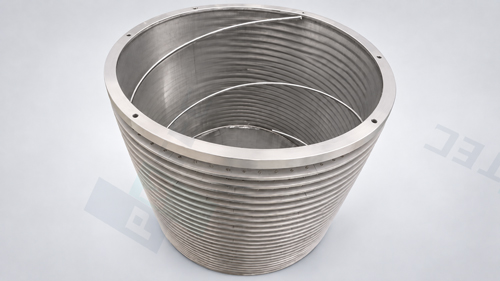
How do the main screen basket types compare?
| Type | How the openings are made | Strength | Limitation |
| Drilled | Holes drilled or punched in plate | Robust; suited to coarse screening | Low open area; not for fine screening |
| Milled slot | Slots milled or sawn into a solid or formed plate | Strong body; fine slots possible | Slots need deburring; lower open area than wedge wire; more machining |
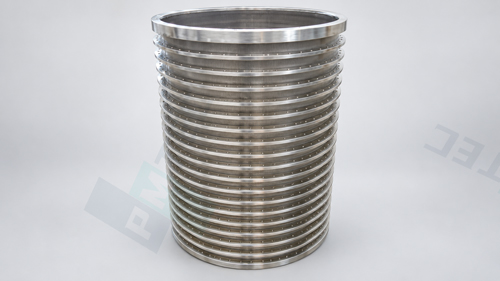
| Wedge wire | Profiled bars fixed to support rings | High open area from continuous slots; repeatable bar profile | Slot width depends on how bars are positioned and fixed; welded ring joints are fatigue-sensitive |
| Welding-free stacked ring | Bars and rings joined mechanically by riveting | No weld distortion or residual stress; slot follows part accuracy | Tight part tolerances; harder to manufacture |
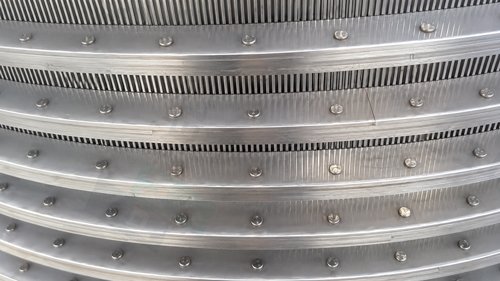
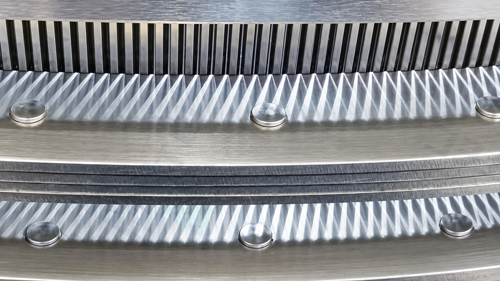
Welded or welding-free: what changes in service?
Welding puts heat into thin bars next to heavy rings. The bars move, and the slot width moves with them. The weld zones also keep residual stress, and under strong rotor pulsation the ring joints are where fatigue cracks usually start. Some mills that have had ring cracking on welded wedge-wire baskets go back to milled or drilled baskets and accept a loss of capacity in exchange for life.
A welding-free design removes the heat input. In a riveted, stacked-ring construction:
- Multi-layer rings are joined by riveting, which spreads the pulse load and removes weld toes as crack starters.
- Wedge-profile bars open toward the accepts side, so particles do not wedge in the slot.
- Interlocking toothed rings locate each bar, which reduces slot-width scatter.
- Bars are held mechanically, so rigidity comes from the structure and not from weld seams.
The cost is manufacturing difficulty. Slot width is set by part accuracy and assembly location, so both must be tightly controlled.
What slot width tolerance should a fine screen basket meet?
| Nominal slot width (mm) | At least 95 % of slots (mm) | All slots (mm) |
| 0.10 – 0.20 | ±0.01 | ±0.02 |
| 0.21 – 0.40 | ±0.015 | ±0.02 |
| 0.41 – 0.60 | ±0.02 | ±0.03 |
The absolute tolerance narrows as the slot narrows. Acceptance should check both columns: most slots in the tight band, every slot in the wide band.
How is screen basket slot width inspected?
- Divide the basket height into top, middle and bottom zones.
- Measure slots in each zone with feeler gauges or a dedicated slot gauge and log each reading.
- Calculate the mean slot width and the share of slots inside the tolerance band for each zone.
- Plot the distribution of measured widths around the nominal value and check for a tail of oversize slots.
- Supply the record with the basket.
Ask for this record on delivery. A report that gives only a mean value cannot show whether oversize slots are present.
How do you select a coarse or fine screen basket?
| Item | Coarse screening | Fine screening |
| Purpose | Remove large debris and fibre bundles; protect downstream equipment | Remove small contaminants and stickies; secure stock cleanliness |
| Opening type | Holes, or wide slots | Fine slots set to the process target |
| Selection focus | Capacity, resistance to plugging, structural strength | Slot accuracy, slot uniformity, open area |
| Typical position | Pulping and waste paper stock preparation, front end | Approach flow and stock preparation before the machine |
Slot width also sets the pressure drop. At the same throughput, a narrower slot or lower open area needs more pressure drop, so basket selection and screen operating pressure have to be considered together.
Data needed to select a basket:
- Screen model, basket inner and outer diameter, effective height.
- Flow direction (inflow or outflow) and rotor type.
- Stock type (virgin fibre, recycled fibre, straw, bamboo) and feed consistency.
- Throughput, feed-to-accepts pressure drop, allowable reject rate.
- Target slot width or hole size, and the stickies removal requirement.
- Material requirement and operating environment, including corrosive media and sand content.
- Service life and failure mode of the existing basket.
For rebuilds the last item matters most. Cracking points to structure, contaminant carry-over points to slot width, and plugging points to a recheck of slot width against consistency.
What causes screen basket problems?
| Symptom | Likely cause | What to check |
| More contaminants in the accepts | Slots worn wider, or cracks in the basket | Measure slot width; inspect rings and bars |
| Pressure drop up, throughput down | Slots plugged by fibre or stickies, or slots too narrow | Check consistency and rotor clearance; clean and remeasure |
| Cracking at the rings | Pressure pulsation fatigue, or weld residual stress | Check construction type; analyse pulse source |
| Local slot wear | Sand or other hard contaminants in the stock | Check that upstream sand removal is working |
| Rapid plugging after a consistency change | Consistency above design | Compare feed consistency with the design value |
| Unstable results after fitting a new basket | Scattered slot widths, or basket not matched to the original duty | Request the inspection record; recheck selection data |
What does screening performance mean for the rest of the line?
Contaminants that pass the screen are not removed later. Stickies carry on to the approach flow and headbox, where they can build up on the lips and slice, then transfer to the wire and press felts and show up as holes, marks and web breaks. For this reason the screening stage is specified together with the cleaners and the approach flow, not on its own.
Frequently asked questions
Does a smaller slot always give cleaner stock?
No. A narrower slot raises the pressure drop and cuts capacity. Choose the slot for the cleanliness target and the throughput together.
Can a worn basket stay in service?
Worn slots pass more contaminants. Measure slot width at planned shutdowns and replace the basket when it falls outside what the process allows.
What must be checked when ordering a replacement basket?
Inner and outer diameter, effective height, flange and locating details, rotor clearance, and slot width or hole size.
About PMTEC
PMTEC is a paper mill system integrator, and screening equipment, including screen baskets, is configured to the stock preparation and approach flow conditions of each line. The slot accuracy and construction points in this article are the basis for specifying the screening stage.